Insights · 2026-02-16
What is RAG? How Your AI Gets a "Photographic Memory" for Your Files
📚 RAG = Verified Knowledge Instead of AI Guesswork
"AI just makes everything up." — We hear this constantly. And honestly: It's true. Partly.
Imagine an incredibly confident intern. He's read unbelievably much — millions of books, articles, websites. He can talk about almost any topic and sounds convincing while doing it. The problem: When he doesn't know something, he won't admit it. Instead of saying "No idea," he invents an answer that sounds right. Complete with case numbers that don't exist, statutes he's cobbled together, and court rulings that were never made.
That's exactly how ChatGPT works. It has no real knowledge. It has learned patterns. It knows how a correct answer should sound — but not whether it's true.
In technical terms, this is called hallucination. The AI invents facts. Not out of malice, but because that's how it's built: It completes text. Always. Even when there's nothing to complete.
Ask ChatGPT about common legal concepts, you'll usually get something usable — they're mentioned thousands of times on the internet. Ask it about a specific court ruling from a specific date, and it gets creative. And "creative" is the last thing you need with a client file.
For a law firm or medical practice, this isn't just annoying. It's dangerous. A medical report with invented lab values. A legal brief citing a ruling that never existed. These aren't hypothetical scenarios — this happens. Regularly.
The Solution is Called RAG — and It's Simpler Than It Sounds
RAG stands for Retrieval Augmented Generation. Sounds clunky. It's not.
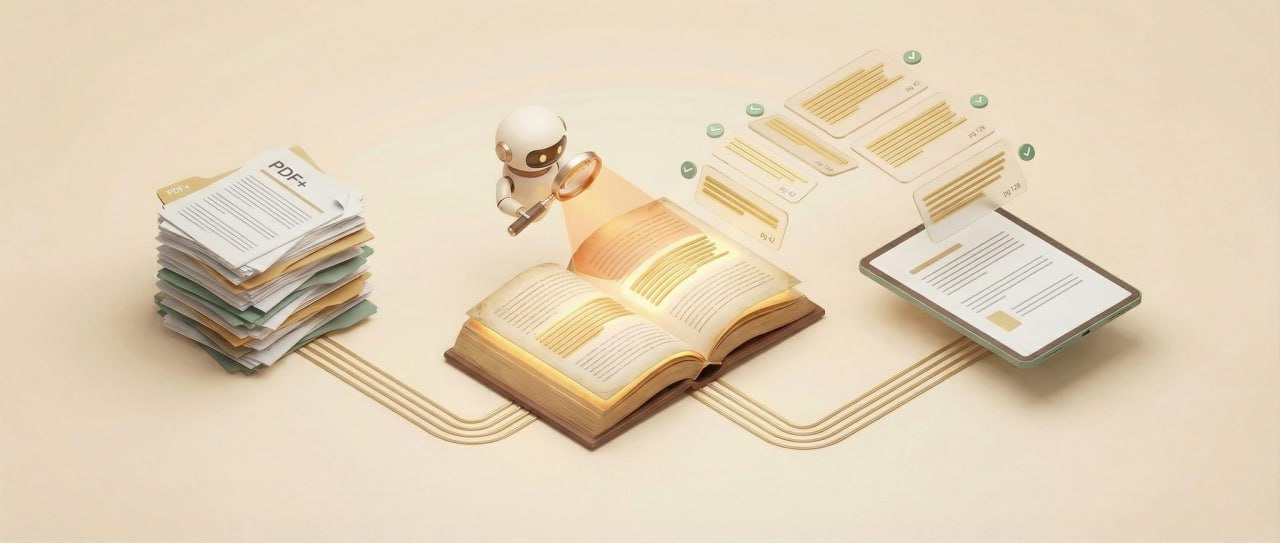
Imagine a librarian. Not just any librarian — the best one you've ever had. You ask them a question. They don't guess. They turn around, walk to the right shelf, pull out the right book, open to the right page, and read you the answer. Word for word.
That's RAG.
Instead of answering from vague "world knowledge," the AI takes two steps:
Step 1 - Retrieval (Search). The AI goes to your "bookshelf" - your local document collection. Your question isn't matched by keywords (that would be a normal search function), but by meaning. The system understands what you mean, not just which words you use. Ask about "notice periods in the client's lease," and it finds the right paragraph, even if it uses different terminology like "termination clause" instead.
Step 2 - Generation (Answer). Only now does the AI come into play. But unlike ChatGPT, it doesn't answer from memory. It's presented with the found text passages — essentially laid on the desk — and formulates its answerexclusively based on those. It quotes. It references the source. It stays with what's in your documents.
The Difference: Normal AI guesses. RAG-AI looks it up — and tells you where it found it.
What This Means for Your Daily Work
A few scenarios our clients actually use:
Law Firm - File Research. 200-page litigation file as PDF. You ask: "When did the plaintiff first assert defect claims?" The AI searches the entire document and gives you the passage - with page number and quote. In seconds instead of hours.
Medical Practice - Medical Reports. 15 findings, 3 lab reports, one MRI report. You ask: "Summary of relevant prior findings for the specialist letter." The AI extracts the core data and delivers a structured draft. No more copy-paste marathon.
Tax Consulting - Contract Analysis. Working through a 40-page partnership agreement. The AI finds the clauses on profit distribution, succession planning, and non-compete agreements — and summarizes them, with references to the respective paragraphs.
In every case: The AI only answers based on what's in your documents. No more. No less.
Where Do Your Data Live in All This?
Good question. And the answer is crucial.
The documents are stored in what's called a vector database. This is a specialized database that doesn't search by keywords, but by semantic similarity — meaning. Your PDFs, medical reports, and contracts are converted into these vectors during import and stored encrypted.
With a local solution — and that's the only thing we're talking about here — this database sits on your hardware. In your office. Behind your firewall.
No cloud upload. No external access. The data is where it belongs: with you.
Technical Note: The vector database doesn't store your original documents as plain text. It stores mathematical representations (embeddings) and encrypted text fragments. Even if someone copied the database - without the decryption key and the associated model, the data is useless.
Hallucination Isn't a Law of Nature
Remember the overconfident intern from the beginning? RAG turns them into a conscientious employee. One who says: "Hold on, let me check" - and only answers once they've found the passage.
When the AI finds no relevant passage in your documents, a well-configured RAG system says: "I have no information on this in the available documents." No guessing. No improvising. No invented case numbers.
And that's the crucial point: You no longer have to suspiciously re-read the answers, because the AI shows you where it got the information. Every statement is verifiable. Every quote has a source. That's the difference between a tool you can trust and one you have to constantly check.
No Wizardry. No Server Farm.
RAG sounds like a major project. It's not. A modern desktop PC with an NVIDIA GPU, the right open-source models, and a clean configuration — that's all you need to run a RAG system that can search hundreds of documents. Fast enough for daily practice. Secure enough for professional confidentiality requirements.
The technology is here. The only question is whether you'll use it.
→ To see how this technology scales in operations, read: The First Employee Who Never Sleeps — or run the AI Hardware Calculator
→ For infrastructure planning: Open the AI Hardware Calculator
Next Step: RAG in Your Practice
See How AI Searches Your Documents Without Hallucinations
We'll show you in 30 minutes how RAG works with your real files — locally, securely, verifiably.
Related Reads
This article explains the technical fundamentals in simplified form. For an individual assessment of whether RAG is suitable for your law firm or practice, contact us.